News
- [Sep. 26, 2026] My first-authored paper was accepted to NeurIPS 2026.
- [Mar. 20, 2026] Our team achieved 3rd place in the PVUW MeViS-Audio Track at CVPR 2026.
- [Mar. 9, 2026] Dynin-Omni, where I contributed to the video understanding component, was announced.
- [Feb. 23, 2026] My first-authored paper was accepted to CVPR 2026.
Introduction
I am a student researching computer vision and machine learning at Seoul National University, in the Interdisciplinary Program in Artificial Intelligence.
My goal is to build systems that represent, understand, and generate complex visual worlds, and use these capabilities to solve real-world problems.
Education
- M.S. in Artificial Intelligence (Interdisciplinary Program), Seoul National University (2025 – Present)
- B.S. in Computer Science and Engineering, Korea University (2019 – 2025)
Research Experiences
-
Research Assistant, AIDAS Lab, Seoul National University, Korea (Aug. 2025 – Present)
Advisor: Prof. Jaeyoung Do -
Research Intern, AIDAS Lab, Seoul National University, Korea (Jan. 2025 – Aug. 2025)
Advisor: Prof. Jaeyoung Do -
Research Intern, MLV Lab, Korea University, Korea (Jun. 2023 – Dec. 2024; now at KAIST)
Advisor: Prof. Hyunwoo J. Kim -
Research Intern, AI Lab, Korea University, Korea (Oct. 2020 – Jan. 2021)
Advisor: Prof. Dongsuk Yook
Publications
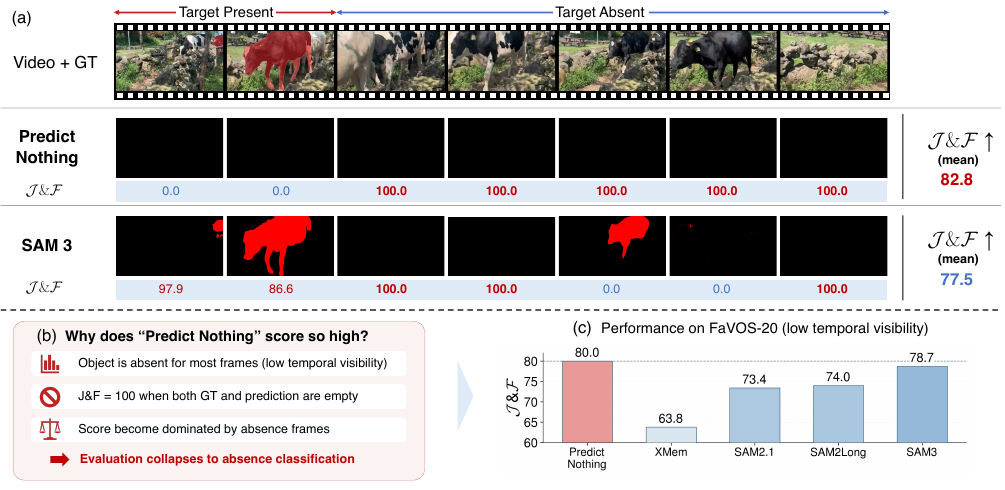
When Predicting Nothing Beats SAM 3: Revisiting Evaluation in Video Object Segmentation
Jihwan Hong, Woohyeon Park, Jaeik Kim, Jaeyoung Do†
40th Annual Conference on Neural Information Processing Systems (NeurIPS), Evaluations and Datasets Track, 2026.
TL;DR
We identify a critical flaw in frame-wise J&F, the standard evaluation metric for video object segmentation: when target objects are rarely visible, predicting empty masks can outperform strong models such as SAM 3.
We introduce FaVOS to systematically evaluate this failure and propose volumetric J&F to address it.
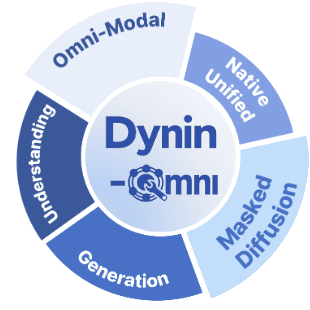
Dynin-Omni: Omnimodal Unified Large Diffusion Language Model
Jaeik Kim, Woojin Kim, Jihwan Hong, Yejoon Lee, Sieun Hyeon, Mintaek Lim, Yunseok Han, Dogeun Kim, Hoeun Lee, Hyunggeun Kim, Jaeyoung Do†
arXiv preprint, arXiv:2604.00007, 2026.
TL;DR
Dynin-Omni is an omnimodal discrete diffusion foundation model that unifies text, image, video, and speech understanding and generation through iterative refinement and bidirectional token modeling.
My role: I extended MMaDA's image understanding module to video, designing the architecture and training recipe for video understanding and video-to-speech generation.
VIRST: Video-Instructed Reasoning assistant for SpatioTemporal Segmentation
Jihwan Hong, Jaeyoung Do†
Proceedings of the IEEE/CVF Conference on Computer Vision and Pattern Recognition (CVPR), 2026.
[Project] [Paper] [arXiv] [Code]
TL;DR
VIRST performs referring video object segmentation (RVOS), identifying and segmenting a target object throughout a video based on a text description.
By fusing visual features from the segmentation encoder and semantically aligned features into learnable tokens, alongside multiple anchor frames updated as the video progresses, VIRST achieves state-of-the-art results on all four evaluated RVOS benchmarks.

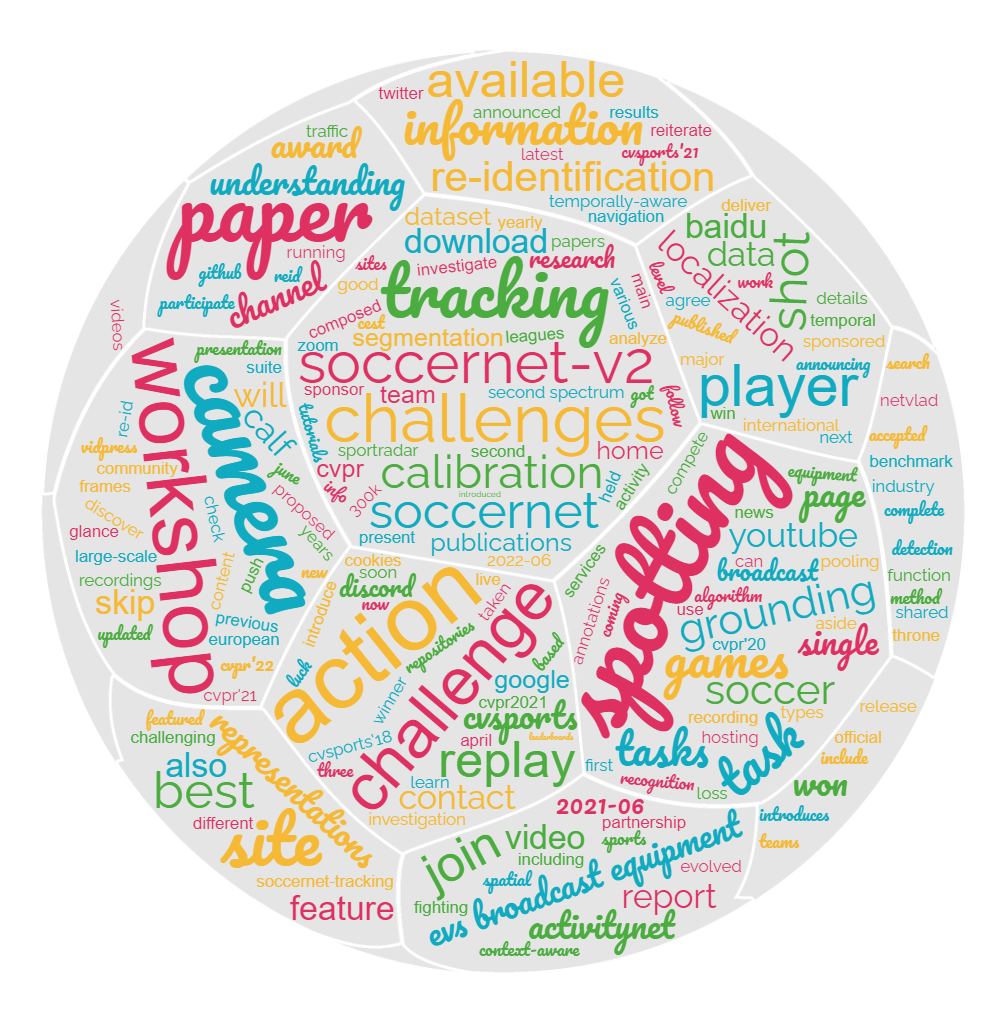
SoccerNet 2024 Challenges Results
Anthony Cioppa et al.
arXiv preprint, arXiv:2409.10587, 2024.
Awards & Honors

3rd Place, 5th PVUW Challenge MeViS-Audio Track at CVPR 2026
CVPR 2026 Pixel-level Video Understanding in-the-Wild (PVUW) Workshop
3rd Place of MeViS-Audio Track of the 5th PVUW: VIRST-Audio
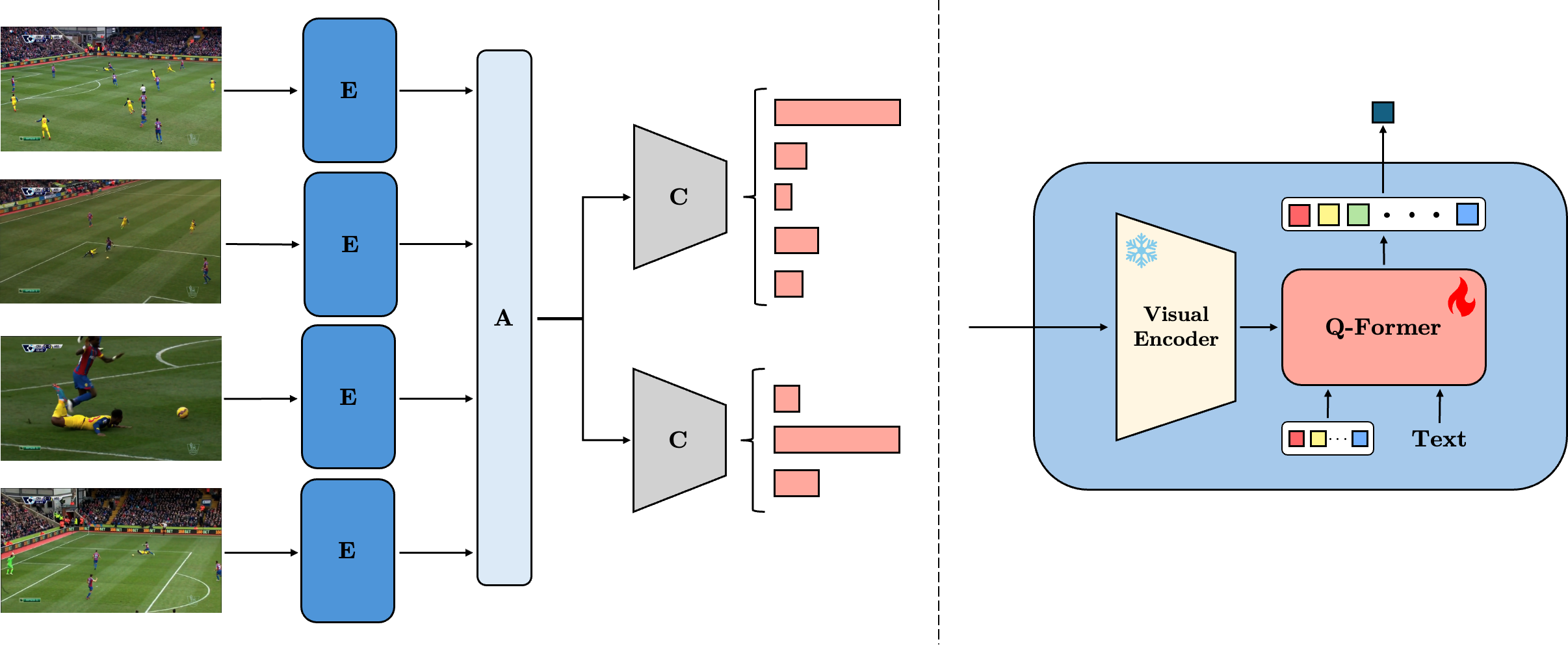
2nd Place, CVPRW 2024 SoccerNet Challenge Multi-View Foul Recognition 2024
CVPR 2024 CVsports workshop
VF-VARS: Leveraging Video Foundation Models for Video Assistant Referee Systems
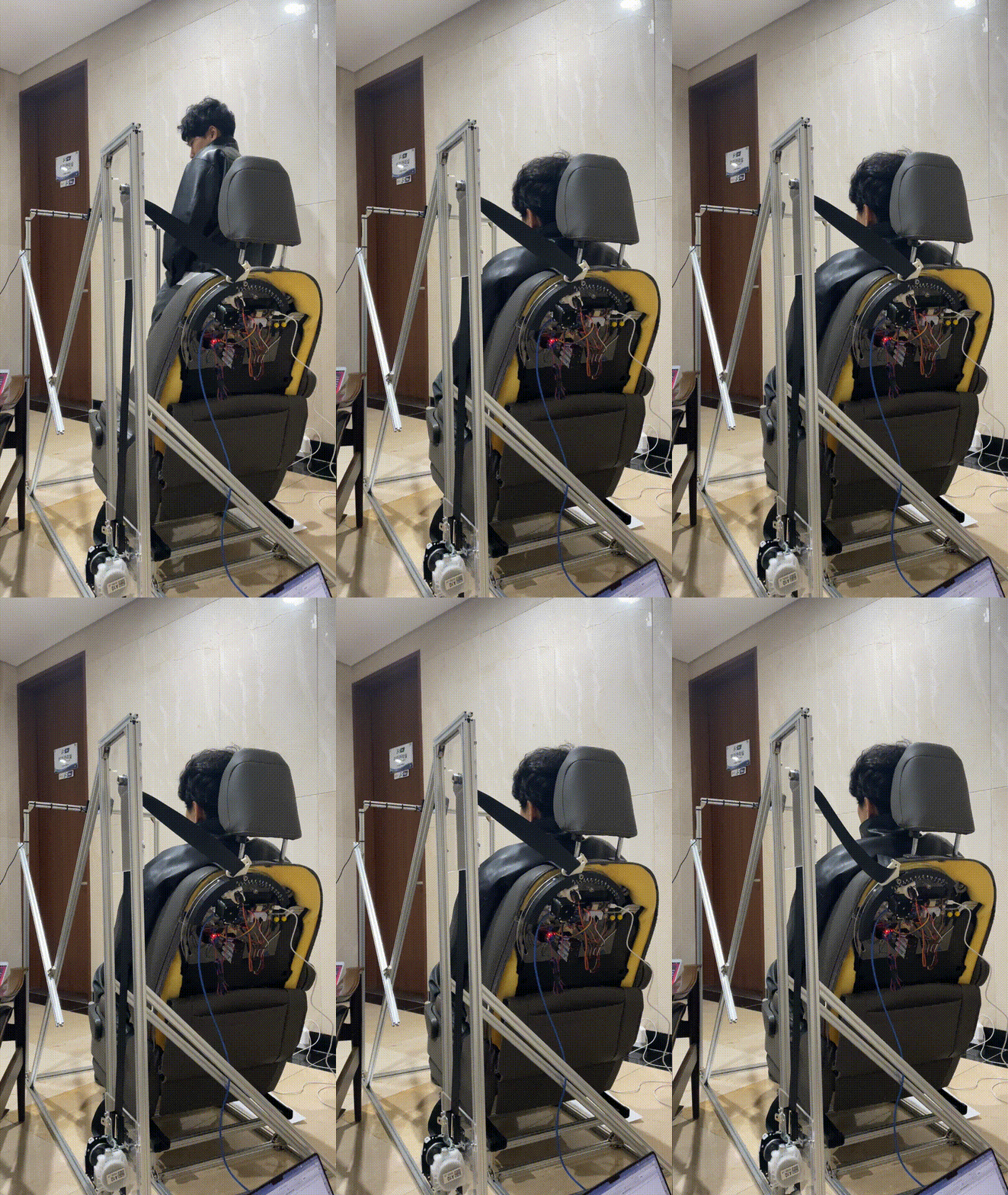

Silver Prize, The 29th Korea Olympiad in Informatics
Ministry of Education, Science and Technology, Republic of Korea
Academic Service
Patents
- To be added
Language
- Korean
- Native
- English
- Advanced
- TOEFL: 5.0/6 (CEFR C1; ≈100/120 on the previous scale)
- Chinese
- Lower Intermediate
- HSK (汉语水平考试) Level 3: 288/300
Contact
- Email: csjihwanh at gmail dot com
- Email: csjihwanh at snu dot ac dot kr
- Linkedin Account
- Blog
- Personal Korean Blog (Deprecated)